
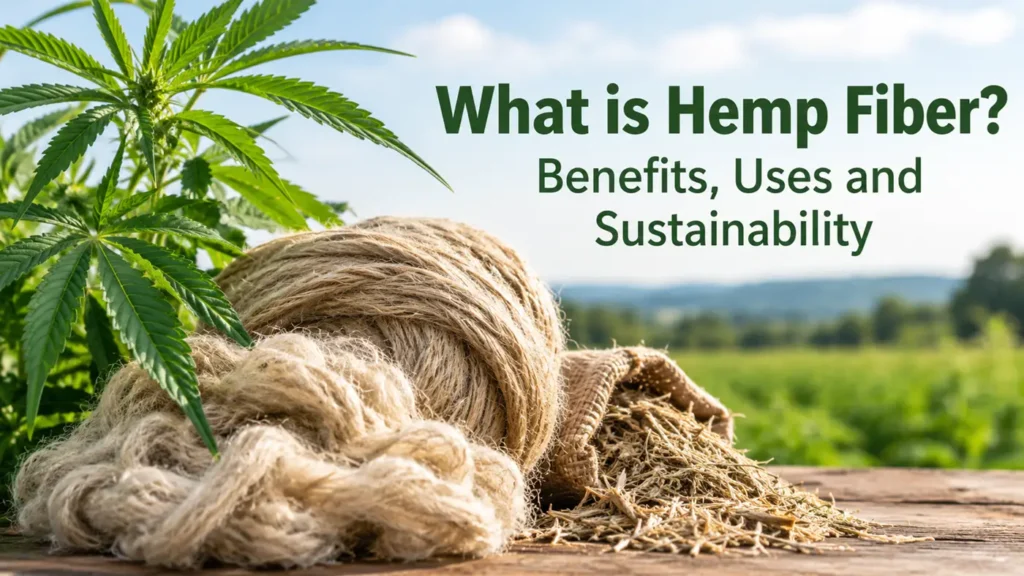
Sustainable Hemp Fiber Growing from the Farm
Perhaps the next major innovation in textiles won’t be manufactured in a laboratory but will instead be grown in a field.
Hemp fiber is now playing a part in the modern discussion about sustainable textiles. It is mainly obtained from the stalk of Cannabis sativa and is famous for its strength, durability and versatility. At present, it is being looked at for use in clothing, home textiles, accessories, technical textiles and other value-added products.
India is giving growing attention to hemp and other natural fibers. At a national seminar on new-age fibers in May 2026 the Ministry of Textiles mentioned hemp together with fibers such as flax, bamboo, banana, nettle and pineapple and connected these materials with sustainable development, agricultural diversification and value-added products.
What is Hemp Fiber?
Hemp fiber is a natural bast fibre which is obtained from the stem or stalk of the hemp plant; after harvesting the stalks are subjected to various processes including retting, drying and fibre separation in order to remove the woody material and liberate the useful fibres.
The fibre thus obtained can be turned into yarn and then woven or knitted into fabrics, or it can be mixed with other fibres such as cotton, bamboo or wool in order to obtain different textures and performance properties.
Industrial hemp is grown for uses such as producing fiber and seed, rather than for the purpose of being psychoactive. Under India’s NDPS Act, governments may permit the cultivation of cannabis plants for industrial uses in order to obtain fiber or seed, provided that the relevant conditions are met.
Hemp Fiber in India
India has for a long time made use of natural fibres, but the commercial development of hemp fibre is still a sector in evolution.
A 2025 report by the USDA Foreign Agricultural Service stated that India’s market for hemp fibre was growing in line with the international demand for sustainable fibers; the report also mentioned that domestic cultivation was still highly regulated and that India imported processed hemp fiber in order to meet some of its textile and export needs.
Research and development are likewise being carried out in the field of natural fibres, and the Central Institute for Research on Cotton Technology under ICAR has identified high-quality fibre extraction, cleaner processing technologies, and new uses in the areas of apparel, home textiles and technical textiles as the key research areas relating to natural fibres.
What is the Process of Producing Hemp Fibre?
The journey from hemp plant to fabric involves several stages:
Cultivation
Suitable industrial hemp varieties are grown in accordance with applicable state regulations and agricultural practices.
Harvesting
The main reason for harvesting the mature plants is to obtain their stalks when they have reached the correct stage for fibre production.
Retting
The stalks undergo retting, a process that helps separate the useful fibers from surrounding plant material.
Fiber Extraction
The long bast fibers are separated from the woody core by means of mechanical or other processing methods.
Processing and Spinning
The fibers are cleaned, treated, and turned into yarn.
Weaving or Knitting
The yarn can then be converted into fabrics for clothing, accessories, home textiles and other applications.
Modern research is increasingly focused on making fiber extraction cleaner, more efficient, and commercially viable.
Benefits of Hemp Fiber
Strong and Durable
Hemp fiber is valued for its tensile strength and durability, making it suitable for products that see regular use.
Versatile
Hemp can be used in a number of product categories, including clothing and bags, upholstery and technical textiles.
An Alternative Made From Natural Fibers
As different industries look for alternatives to conventional textile materials, hemp provides plant-derived options.
It is Possible That Less Water Will Be Required
Hemp is generally seen as requiring less water than cotton, though the actual amount used varies by variety, climate, the farming method, and irrigation system. The Department of Science and Technology in India has also pointed out that hemp uses less water than cotton for industrial fiber production.
It Supports Innovative Development in the Field of Textiles Sustainably
Hemp is part of a wider initiative to develop natural and biodegradable fiber systems, with ongoing research and industrial exploration of its use in sustainable and other new applications.
Uses of Hemp Fiber
Hemp fiber is no longer limited to traditional ropes and coarse materials; its uses include:
- Clothing and Fashion Textiles
- Bags and Accessories
- Home Furnishings and Upholstery
- Ropes and Cordage
- Technical Textiles
- Packaging Materials
- Composite Materials
- Blended Fabrics
Research is also underway on using natural fibers in reinforced composites and other industrial applications, offering potential opportunities beyond conventional textiles.
Hemp Fiber and Sustainable Fashion
Growing pressure on the fashion industry to reconsider how fibers are produced, processed, and disposed of has increased interest in plant-based materials such as hemp.
Hemp fabrics can also be combined with other fibers to alter their texture, softness, and performance. This gives manufacturers greater flexibility while still keeping some of hemp’s features.
Yet just because something is ‘natural’ does not mean that it has no impact. The environmental footprint of a final hemp product depends on farming methods, retting, processing, transportation, dyeing, and manufacturing.
That is why the future of hemp fiber does not lie merely in growing more hemp, but in building efficient, responsible supply chains.
Challenges of Hemp Fiber
Despite its potential, the hemp fiber industry faces several challenges.
- REGULATORY REQUIREMENTS: Hemp farming in India still follows rules set by each state and applicable laws.
- The equipment needed for fiber extraction, along with the relevant processing facilities, may prevent large-scale production.
- To grow the industry, farmers, processors, textile manufacturers, and brands need strong links to scale one another.
- Achieving competitive costs and consistency remains important for broader acceptance of textile-grade fiber.
- CONSUMER AWARENESS: Hemp is still misunderstood by some consumers because of its association with other cannabis products. Clear communication about industrial hemp and its regulated applications is therefore important.
The Future of Hemp Fiber
The opportunity surrounding hemp is not only about making another type of fabric. It is about creating a farm-to-fiber value chain where agriculture, technology, manufacturing and sustainable design work together.
India’s textile sector is already exploring a broader range of new-age natural fibers, and hemp is part of that conversation.
If cultivation, regulation, processing technology and market demand develop together, hemp could become an increasingly relevant crop within India’s natural-fiber ecosystem.
FAQs about Hemp Fiber
Hemp fiber proves that agriculture can be much more than food production. A single crop can connect the farmer’s field to fashion, manufacturing, rural enterprise and sustainable design.
As the world searches for more responsible materials, hemp fiber offers an interesting bridge between traditional agriculture and the future of textiles.
The real opportunity lies not merely in growing hemp, but in building an efficient ecosystem around it from seed to stalk, stalk to fiber, and fiber to a product people can use every day.